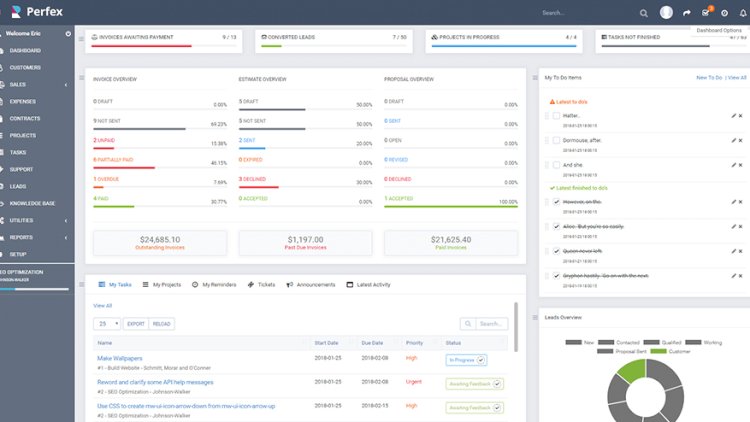
A Customer Relationship Management (CRM) system helps a business manage its relationships with customers: tracking leads, projects, invoices, support tickets and the time spent on each. Building one teaches you how the pieces of a business — sales, delivery and support — connect around the customer.
What a CRM manages
- Customer and contact records
- Projects and tasks linked to customers
- Estimates and invoices
- A support-ticket system
- Time tracking and billing per task
The big idea: everything links to the customer
The defining feature of a CRM is that projects, invoices, tickets and time entries all hang off the customer record, giving one complete view of the relationship. Designing those links cleanly — so you can see a customer’s whole history in one place — is the core lesson.
Technology stack
Typically PHP (often Laravel) with MySQL and a Bootstrap interface. Modules for projects, invoicing and tickets can be built and learned one at a time.
What you’ll learn
Relating many entities to a central record, building invoicing and ticketing modules, and time tracking with billing.
Frequently asked questions
Should I build all modules at once?
No — start with customers and contacts, then add projects, then invoicing, then tickets. Incremental is the way.
How does time tracking tie to billing?
Log time against a task, then convert billable time into invoice line items.
A note on using this project
Use this PHP/Laravel project as a learning reference: read the code, run it locally, and adapt it to your own requirements rather than deploying it unchanged. If you reuse third-party components, check their licences first.
Related projects and guides
Working on this project? These related write-ups on the site are worth a look:
- Service Desk Ticket System
- Individual follow-up Email System
- Capstone Project Ideas with Source Code (2026) — more PHP, Laravel and MySQL project ideas.