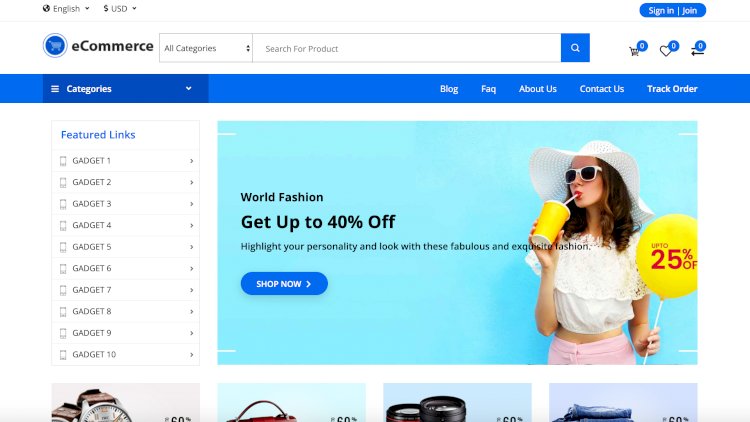
This project is a complete online store with four distinct sides — customer, admin, seller and courier — which makes it an unusually realistic e-commerce build. Each role sees its own dashboard and can only do what its permissions allow.
The four roles
- Customer: log in, manage addresses, place and track orders, cancel orders, leave seller feedback, print invoices.
- Admin: register sellers and couriers, manage products and categories, oversee every order.
- Seller: add and edit products, receive and view orders, print invoices.
- Courier: view assigned orders, update delivery status, print customer and seller invoices.
Why multi-role is worth building
A single-role store teaches you carts and checkout. A multi-role marketplace also teaches you authorization boundaries — making sure a seller can never see another seller’s orders, and a courier can only update deliveries assigned to them. That access-control discipline is exactly what production systems require.
Technology stack
Typically PHP (Laravel) with MySQL and a Bootstrap front end. Laravel’s policies and middleware are well suited to enforcing the four-way permission model cleanly.
What you’ll learn
Role-based authorization across multiple user types, order lifecycle management (placed → shipped → delivered), invoice generation, and how a marketplace differs from a simple shop.
Frequently asked questions
Is this harder than a normal online store?
Yes, mainly because of authorization — but that is the most transferable skill it teaches.
Can I drop the courier role?
Absolutely. Start with customer/admin/seller and add couriers once the order flow is solid.
A note on using this project
This guide is written to help students and developers understand how a PHP/Laravel application like this is designed and built. Treat any sample code as a learning reference: read it, run it locally, and adapt it to your own requirements rather than shipping it unchanged. If you reuse third-party components, check their licences first.
Related projects and guides
Working on this project? These related write-ups on the site are worth a look:
- eCommerce CMS
- Online Auctioning System
- Capstone Project Ideas with Source Code (2026) — more PHP, Laravel and MySQL project ideas.