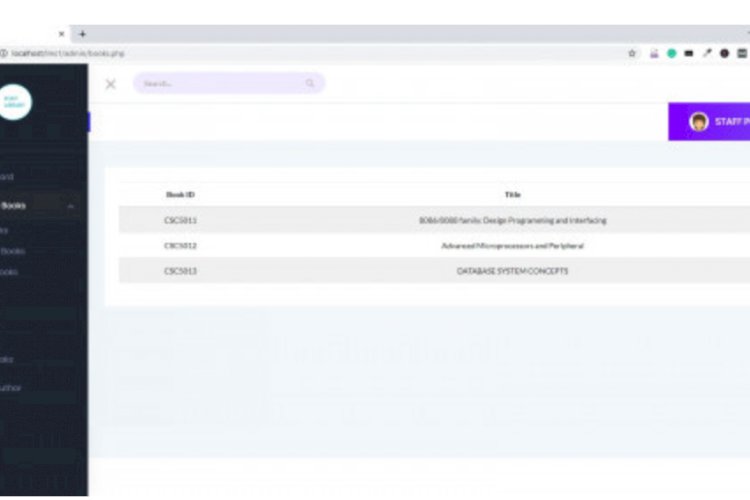
A library management system digitises the everyday work of a library: cataloguing books, registering members, and handling the issue and return of books — including fines for late returns. It’s a classic project because the borrow/return cycle is simple to grasp but rich enough to teach real data modelling.
What it manages
- Books organised by category
- Members of different types
- Issuing and returning books in a click
- A configurable day-limit and fine system
- Search across books and members
The core logic: issue, return, fine
When a book is issued, the system records who has it and when it’s due. On return, it compares the date to the due date and calculates any fine. Preventing a book from being issued twice, and tracking availability accurately, is exactly the kind of state management real systems depend on.
Technology stack
PHP with a MySQL database and a web front end. The schema is compact — books, members, and an issues/returns table — which makes it ideal for learning relational design.
What you’ll learn
Many-to-many relationships, availability tracking, date-based fine calculation, and search.
Frequently asked questions
How are fines calculated?
On return, compare the return date with the due date and multiply overdue days by your fine rate.
Can a book be reserved?
Yes — add a reservations table so members can queue for a title that is currently issued.
A note on using this project
Use this PHP/MySQL project as a learning reference: read the code, run it locally, and adapt it to your own requirements rather than deploying it unchanged. If you reuse third-party components, check their licences first.
Who is this for
Students who need an approachable capstone or class project, beginners moving from single-table CRUD exercises to real relational design, and anyone who wants a codebase small enough to read end to end in an afternoon. School and community libraries can also use it as the seed of a genuinely useful internal tool, since the borrow/return workflow it implements is the one they run every day.
Ideas for extending the project
The compact schema makes extensions easy to reason about. Barcode scanning for book check-in and check-out removes manual lookup at the desk. A reservations queue lets members wait for a popular title and get it in fair order. Email reminders a day before the due date cut late returns — and teach you scheduled jobs. Reports on most-borrowed titles and most-active members turn the issues table into management insight. Each addition maps to one or two new tables, so the database stays understandable as it grows.
Related projects and guides
Working on this project? These related write-ups on the site are worth a look:
- Library Management System
- 6 Best Open-Source Library Management Systems (2026)
- Capstone Project Ideas with Source Code (2026)